A Leader’s Role in the Adoption of AI
By Jeni Craswell
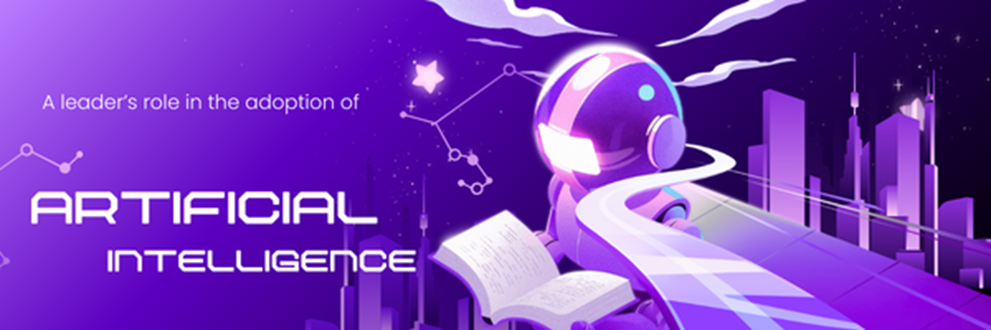
Purple background with futureistic buildings and highways, a robot reads a book. Words read “A Leaders’s Role in the Adoption of AI”
The world right now seems to be changing at lightning-fast speeds and particularly as the introduction and explosion of AI is promising to be a game changer that has been compared to the introduction of electricity. [1] There are endless possibilities in how AI can change the game of the work that we do. Right now, there is an overwhelming push to “use our product” in what feels like an intense market-share grab by companies to position themselves as “the” AI provider. AI is offering to read my emails, tell me where to buy a pair of shoes that pop up on my phone, write a better speech and control my online meetings, “adjust my sound”, take my
notes, and even make me look like I put on make-up this morning.
In many ways, AI – if it’s made available to all – could be the great equalizer. It already allows new programmers to create code far beyond their understanding, and tired nonprofit execs to write a letter that they are too overwhelmed to properly create. AI will help businesses save time and is being touted as the great savior for nonprofits who are habitually understaffed. The potential impacts to science are truly mind-boggling and exciting. Every day there is a new story about the positive opportunities being generated because of AI.
At the same time, we are hearing about research that says physical books and pencil to paper (as opposed to screens) are shown in studies to be critical to building focus and understanding and opening up neural pathways in students. [2]
Artists are rightfully concerned because their art is being used to build data for the AI engines and even the actors union had to add a clause in their contracts preventing studios from using their images and voices to create AI generated content.
AI may be a great equalizer, however if everyone starts using AI to write speeches and papers, then there will again be a great white-washing and re-definition what a “proper” article or speech looks like. When the AI engines start determining acceptable communication, we lose the many distinct and diverse voices in the room.
We are already seeing the influx of AI generated articles, posts and communication and it is becoming increasingly challenging to know what is human generated and what is AI generated).
This is just the tip of the iceberg and doesn’t even touch on the environmental impact, potential loss of cognitive skills and the very real concern that, at some point, when “AI” becomes true artificial intelligence, humans won’t have the understanding or the skills to keep it in check. [3] Not to mention the recent stories of Open AI offering the government un-checked AI in an attempt to throttle the huge growth of Anthropic who refused to remove the guard-rails. [4] As leaders, we continually balance the desire for early adoption with the responsibility for understanding the impacts of what we choose to bring into our organizations. Nonprofits are
being offered AI tools - many of them free – at an astounding rate. I received an email yesterday offering a tool that will build relationships for me by responding to every email within five seconds of receiving it. We are being pushed for more, faster, better. But is that what we will actually get? And even if it is, what are the consequences?
I am working daily to understand both the positive and the negative impacts of AI on an organization, on humans and on the work we produce. As a nonprofit leader looking to differentiate from other organizations, AI seems to offer the opposite. I want the individual voices of our staff, board and volunteers to be heard and to offer unique messages and insights.
Every leader in today’s world needs to make decisions on where and when AI should be implemented and then keep an eye on how it is both positively and negatively impacting their organization and the results they are driving toward.
For me, I’m going slow, testing, and reading a lot of these early studies on impact. I can’t tell you where we will land, however I am firmly committed to my role as leader in seriously evaluating before adopting. I am looking forward to a conversation with others as we navigate the incredible possibilities as well as intended and unintended impacts of this game changing technology.
While I am excited for some of the ways that AI can support the work I do, I will always value and prioritize human creation, human communication, and human relationships. I invite you to join me in the conversation as we work together to navigate both the positive and the potential negative impacts of AI.
Jeni
Endnotes:
1 https://www.gsb.stanford.edu/insights/andrew-ng-why-ai-new-electricity
2 https://www.afterbabel.com/p/sweden-went-all-in-on-screens-in
3 https://fortune.com/2025/07/22/researchers-ai-labs-google-openai-anthropic-warn-losing-ability-understand-advanced-models/
4 https://www.npr.org/2026/02/27/nx-s1-5729118/trump-anthropic-pentagon-openai-ai-weapons-ban

Note: this article was writing without the use of generative AI. I have chosen to include a mark to differentiate between any AI generated communications and work that is solely human generated.